Incantations: Question Map Worksheet:
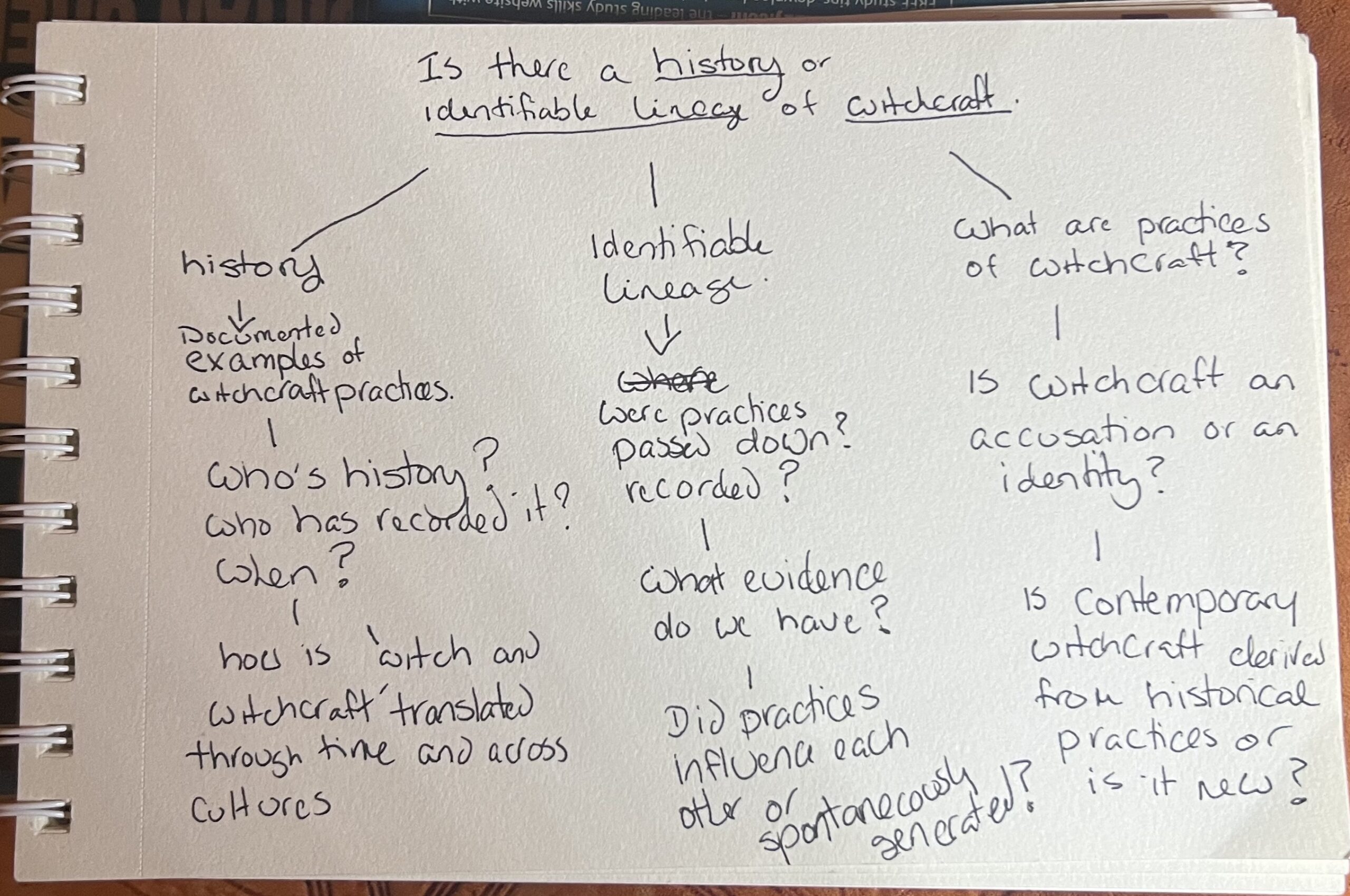
Is there a history or identifiable lineage of witchcraft from which we can draw a definition of ‘witch’?
Statement: By history or identifiable lineage I am looking for evidence of ‘witchcraft’ in Western, European, and Near/Middle Eastern culture. The witch is a global figure, but this study focuses on how the idea of the witch has evolved over time in Europe. I am looking for similarities in material culture – magical objects, written word, and possibly myths and legends that may evolved over time but have recognizable characteristics of witchcraft whether it is in accusations or in actual practice.
Typical usage of the word ‘witch’:
| As an identity as someone who practices a pagan-based belief system. | As someone usually a woman who has psychic, or divinatory powers. | As a fictional hallowe’en figure, or symbol, fictional character in stories. |
| As a real practitioner of magic – both ‘good’ and ‘bad’. | Witch-hunt is also used as a political tool—a defensive claim meant to obscure or discredit accusations made by one’s opponents. This context stems from the idea that actual witch-hunts were hunting anxieties, fabrications. | An old woman who lives alone and apart from society. |
| As an accusation of person causing harm using supernatural means. | As a slur/insult for a woman, like saying ‘bitch’ | As an identity, as someone with supernatural abilities. |
Characteristics:
- Someone who uses metaphysical forces, and/or magic to effect change in the world.
If that was the case, priests would be witches too… maybe they are - They are not ‘authorised’ by a singular external authority.
- They interact with an animate world – all witches are animist, not all animists are witches.
- Skill and craft are learned through study and practice – intuitive feel is innate and witches rely on the intuitive as much or more than skill.
- There is sometimes – but not always – a difference between what an accuser would call witchcraft and what a practitioner would call witchcraft.
Contrasting Case
The Scientist and The Witch – Both seekers of knowledge
| Witch | Scientist |
|---|---|
| relies on personal experience, metaphysical knowledge | scientist relies on repeatable tests and empirical evidence |
| relies on self-validation, sometimes on coven or group | Scientist relies on peer review, collaboration, and confirmation |
| Relies on intuition and feelings | rejects feelings, instincts, and ‘gut-feelings’ |
Borderline Cases:
The Fortune Teller
One might imagine a Fortune Teller as a witch because even a bad one is tapping into the unseen on some level, even if it is only the imagination. But Fortune Tellers can be purely transactional. When the work is done they are no longer fortune tellers. Though I am sure many witches, cunning-men and women and such were also transactional; fortune tellers are not necessarily animistic, don’t rely on magic, and are not operating from the liminal. Obviously there are some who are these things, but their practice of magic is not necessarily on their trade as a fortune teller.
Typical Examples:
| Spell-caster, charm and amulet maker – M, A, l | A practitioner of magic – M, A, L | Devotee of the ‘old-gods’ A, |
|---|---|---|
| A potion-maker, poisoner, m, a | A seer, psychic or medium, dreamworker, m, a, L | A priestess,boundary-keeper-protector, a, l |
| A midwife, or psychopomp L | A healer A | A herbalist – Aa |
| A diviner – A | An astrologer, tarot reader, or possessing other divination – A, l | |
| Fortune-teller, fate-worker- L, m, – SO | ||
| Cunning man/woman – folk practitioner -M, A, l | weather worker -M, A, L | shape-shifter – M, A, L |
| ritualist – m, L | ||
I crossed out any that were accused of witchcraft only, this does not mean I won’t be looking at witchcraft accusations, but only material examples and descriptions of magical practices. The testimonies from the trials are useless. I also crossed out witchcraft as an identify, witches by birth, solo-practitioners, specific traditions or paths – I will only be looking at actual practices. I also crossed out uses of the word witch that are hyperbole, or not referring to the actual practice of the craft.
I was left with 16 ‘types’, some of these could likely be folded into fewer definitions but at this time I see distinctions.
| Spell-caster, charm and amulet maker – M, A, l | A practitioner of magic – M, A, L | Devotee of the ‘old-gods’ A, |
|---|---|---|
| A potion-maker, poisoner, m, a | A seer, psychic or medium, dreamworker, m, a, L | A priestess,boundary-keeper-protector, a, l |
| A midwife, or psychopomp L | A healer A | A herbalist – Aa |
| A diviner – A | An astrologer, tarot reader, or possessing other divination – A, l | ritualist – m, L |
| Cunning man/woman – folk practitioner -M, A, l | Fortune-teller, fate-worker- L, m, – | shape-shifter – M, A, L |
| weather worker -M, A, L |
M – requires on magic, m-might use magic
A – requires animism, a – might be based in animism
L – operates in liminality, l – could be liminal
Material Magic: Spell-caster, charm and amulet maker, potion-maker, poisoner, herbalist
Prophecy/Divination: A seer, psychic or medium, dream-worker, An astrologer, tarot reader, or possessing other divination
As a religous/spiritual practice: Devotee of the ‘old-gods, A priestess,boundary-keeper-protector, ritualist, ritualist
As a trade or profession: A midwife, or psychopomp, An astrologer, tarot reader, or possessing other divination, Cunning man/woman – folk practitioner, A herbalist, Spell-caster, charm and amulet maker, A diviner, weather worker
As Shaman: shape-shifter, A priestess,boundary-keeper-protector,
WORKING QUESTION:
Is there a history or identifiable lineage of magic and witchcraft from which a coherent definition of ‘witch’ can be drawn?
Through the Incantations projects I will be examining historical evidence of magical practices, focusing on a lineage of Western and West-Asian ideas of sorcery, with detours into other cultural practices of magic. I will be looking at witchcraft as a religious/spiritual practice, as a tool for prophecy and divination, as a professional trade, and as folk magic.